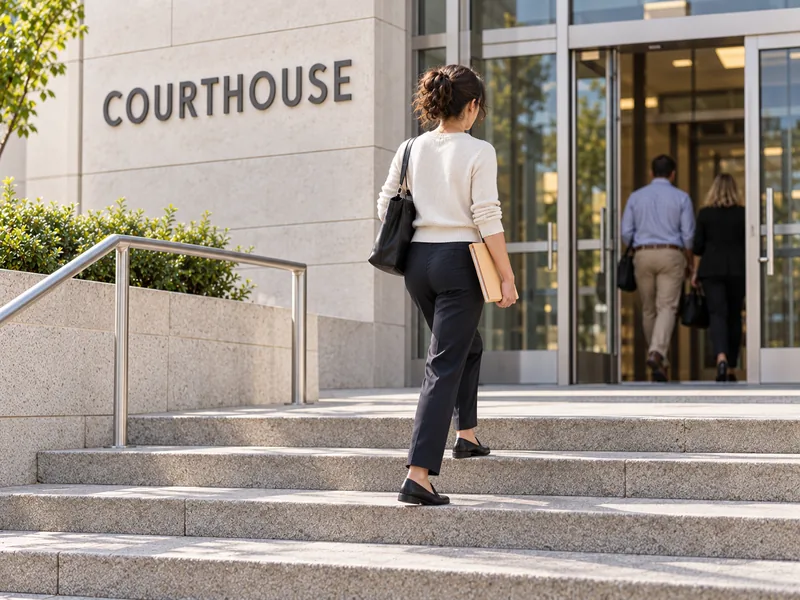
Check your hearing notice and court's dress code
Identify the court, courtroom, and role listed on your notice. Look for clothing instructions for people attending hearings, not just a page addressed to jurors. Check any directions sent specifically for your appearance as well as the court's general visitor information.
We suggest making a short list of the clothing details you need to confirm: for example, a pair of jeans, a head covering, or shoes you need to wear. Use the actual wording instead of replacing a specific requirement with a broad phrase such as look professional. That gives you something concrete to compare with your wardrobe.
When a rule is unclear
If you cannot work out what to wear to court from the notice, contact the court office listed there or ask your lawyer, if you have one, to help confirm the applicable instructions. Explain the clothing question directly. Do not decide on your own to miss, delay, or reschedule an appearance because you are unsure about an outfit. Clothing questions and instructions about attending the hearing need to be resolved with the appropriate contact.
What three court sources actually say
These examples show why a named source and its scope matter when choosing what to wear to court. They are not a national allowed-and-forbidden list.
| Named source | Scope and clothing example | Limit to keep in mind |
|---|---|---|
| Judge Vidmar Dress Code PDF on the District of New Mexico website | Addresses witnesses, jurors, agents, and spectators; includes jeans as acceptable within its listed outfits and requires shoes | The document's date and present applicability have not been confirmed; do not treat it as a current rule for all New Mexico courts |
| Liberty County, Georgia, Magistrate Court dress-code page | Lists ripped clothing and shorts among exclusions; gives religious and medical exceptions to its head-covering restriction | It does not expressly approve every item it does not mention |
| Oregon Judicial Department, Jackson County etiquette page | Its general guidance covers participants, witnesses, jurors, and spectators; requires shoes and lists revealing or abbreviated clothing | Its separate statement that suits, ties, and dresses are not required appears under Jurors |
On a narrow screen, scroll the table sideways.
Liberty County's page also says unsuitable dress may result in being asked to leave and return later, delaying the hearing. That is its stated possible consequence, not a prediction for every court or a statement about how a case will be decided. Source
What to wear to court for women
Trousers, skirts, and dresses
One practical option we suggest is a white blouse, navy trousers, a charcoal cardigan, and black flats, subject to the instructions for your appearance. Try the outfit while seated as well as standing. Check whether the blouse, waistband, and cardigan stay comfortable without repeated adjustment.
Style suggestion; check your court’s instructions.
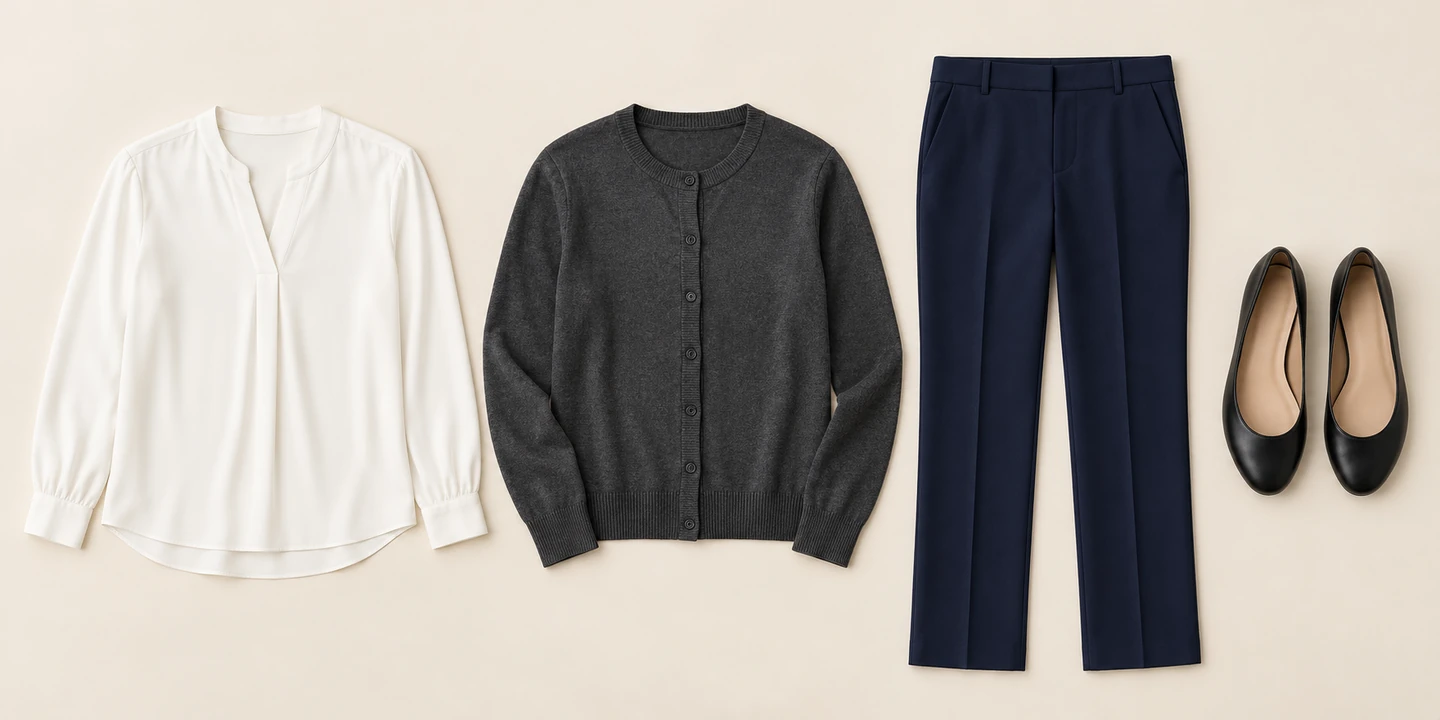
- White blouse
- Charcoal cardigan
- Navy trousers
- Black flats
A dress with suitable shoes and an optional layer is another combination to check. A skirt with a blouse can serve the same purpose. We do not set one skirt length or require heels for all courts. Use the actual instructions if they specify a clothing detail.
For what to wear to court without a dress, start with trousers you already own and choose a top that fits the applicable requirements. If you need specific footwear or clothing for a medical, religious, or disability-related reason, ask the court through its published contact or accommodation channel about your situation. This guide cannot confirm a local exception on its behalf.
Courtroom attire for men, with or without a suit
We suggest a white collared shirt, navy trousers, and comfortable black shoes as a starting combination to check with your court. A jacket is an option if it fits the instructions and your preferences. A suit or tie should follow the actual directions for your appearance rather than an assumption that every role has the same requirement.
Style suggestion; check your court’s instructions.
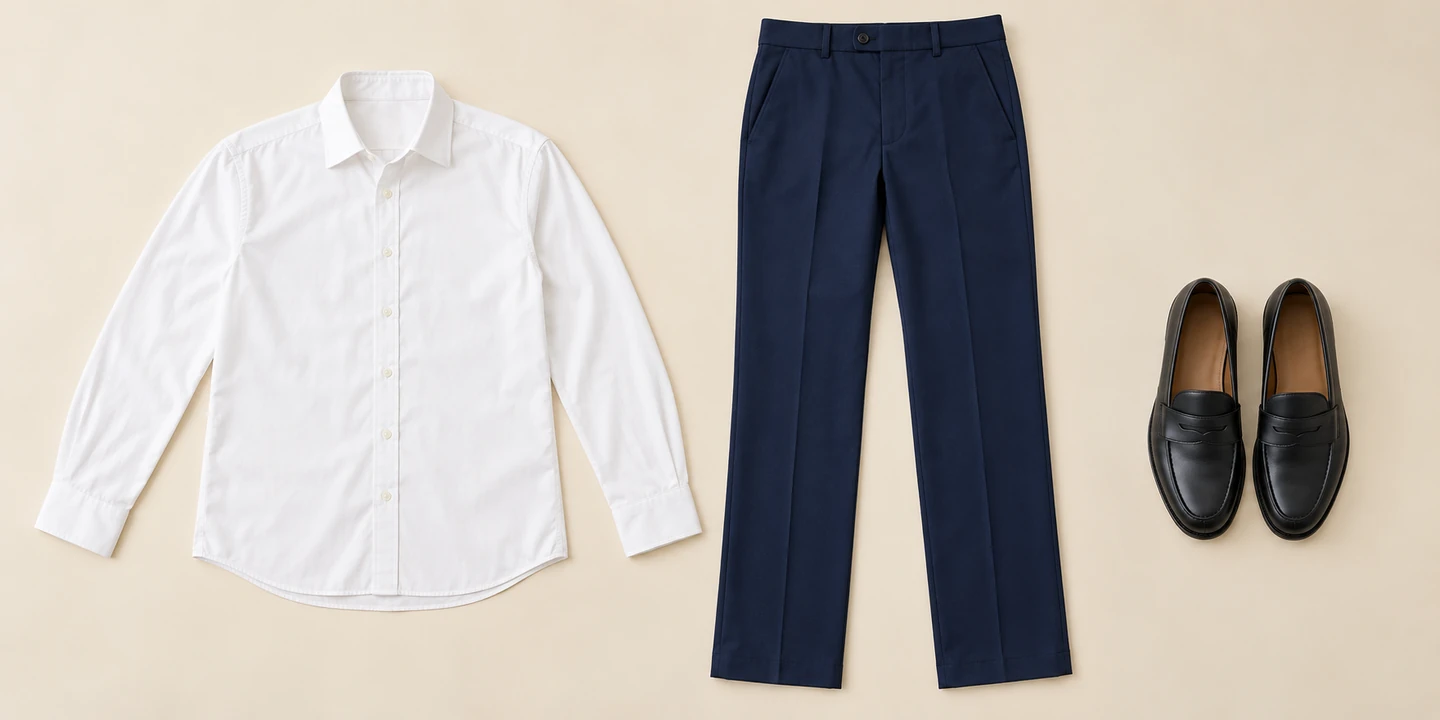
- White collared shirt
- Navy trousers
- Black shoes
Use clothes you already own
When deciding what to wear to court without a suit, begin by identifying the requirements you need to meet. Then look at your existing shirts, trousers, and shoes together. We suggest trying the complete combination before deciding whether something is missing. This page does not require a particular brand or an expensive outfit.
If you cannot meet a stated instruction with the clothes available to you, contact the court or your lawyer for guidance about that problem. Do not treat a clothing suggestion online as permission to ignore a direction or change your attendance arrangements.
Jeans, hats, shoes, and clothes to check first
Can you wear jeans to court?
There is no answer here that guarantees jeans are acceptable for your appearance. The Judge Vidmar PDF expressly accepts them for its listed outfits and roles, but its current applicability is unconfirmed. Liberty County's page excludes ripped clothing; that statement alone does not approve every other pair of jeans. Source Source
For a woman or man asking what to wear to court in jeans, we suggest checking the court's wording about that item first. If the answer is unclear, ask directly. Neat trousers are an alternative to consider if you own them and they meet the instructions, rather than a way to avoid checking the rule.
Can you wear a hat in court?
Liberty County expressly makes religious and medical exceptions to its head-covering restriction. The Judge Vidmar PDF and Jackson County page include hat-removal wording without the same detailed exception wording in the cited sections. Keep those statements separate; do not add or remove local exceptions yourself. Source Source Source
If your head covering relates to religious or medical needs, ask your own court about the applicable instructions before the appearance. A rule quoted from another court does not settle that question.
Shoes, sneakers, shorts, and revealing clothing
Check footwear and coverage specifically. Jackson County's general guidance requires shoes and lists shorts, tank tops, and cropped tops among revealing or abbreviated clothing. Its cited section does not give an affirmative sneaker permission. Source
We suggest shoes you can comfortably walk and stand in, within your court's requirements. If a needed shoe or garment raises a question, describe it to the court rather than assuming an omitted item is approved.
What colors do judges like to see in court?
We do not know your judge's personal color preferences. The three sources cited here do not establish that wearing a particular color changes a judicial decision. A question about a preferred color is not evidence that such a preference exists.
Color choices are style suggestions
For what to wear to court in terms of color, we suggest navy or charcoal with a plain white or other simple top as easy combinations to assemble. These are our style choices, not colors we claim are more credible, more respectful in every setting, or more likely to help your case. This guide does not provide a universal forbidden-color list. Follow any actual clothing instructions you receive rather than relying on a color prediction.
Defendants, witnesses, and observers
Defendants and other parties
Check directions for your particular appearance, including any sent by your courtroom or lawyer. We suggest confirming an uncertain clothing detail with those contacts instead of trying to create a different standard for every type of hearing. This also applies if you are attending about a ticket. Clothing arrangements for people in custody are outside these general outfit suggestions.
Witnesses and observers
The Judge Vidmar document names witnesses and spectators, and Jackson County's general guidance also covers these roles. Do not assume that attending as an observer removes the need to check clothing instructions. Source Source
If you are attending with a family member, confirm your own role and any applicable directions. Choosing an outfit does not, by itself, confirm access to a particular proceeding. Jury-service questions belong in the separate what to wear to jury duty guide.
A practical outfit check before leaving
We suggest checking what to wear to court as a complete outfit:
- Compare the clothes with your notice and applicable court instructions.
- Try sitting, standing, and walking in the outfit.
- Check the footwear and any unresolved clothing questions.
- Choose an optional layer for your own comfort and the journey's weather.
- Keep attendance instructions separate from outfit decisions.
For another setting, return to what to wear by occasion.